Bifacial calculations based on the 3D scene
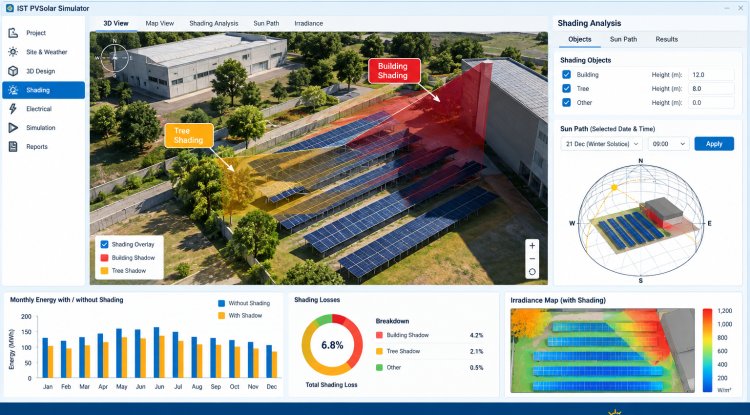
PR Newswire: IST bifacial gain uses the same kind of model as PVsyst’s Unlimited Sheds 2D. Both are 2D view-factor calculations over infinite identical rows. The difference is what IST adds around that model, using the real layout from 3D Shadow Analysis.
Keyword:
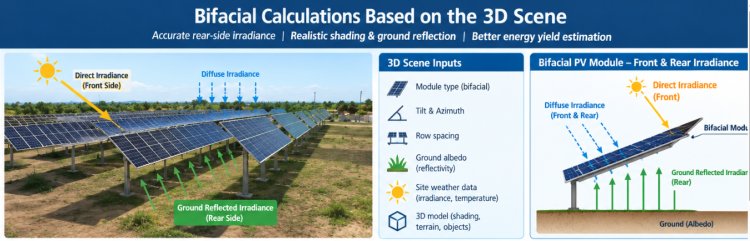
PVsyst does not yet have a bifacial model that calculates rear irradiance from the 3D scene. Its documentation lists that as future work: “Model based on your 3-dimensional shading scene. This will be developed in a next version”. In current PVsyst, the 3D scene only supplies geometry to the same 2D unlimited-sheds or unlimited-trackers model.
So neither tool does true 3D rear-side ray tracing. Both use a 2D view-factor model at their core. The real difference is how much of the 3D scene each one lets affect the rear side.
| Aspect | PVsyst with a 3D scene | IST 3D Shadow Analysis |
|---|---|---|
| Rear-irradiance model | 2D unlimited sheds or unlimited trackers | 2D infinite sheds (pvlib method), plus a separate model for panels on pitched roofs |
| What it takes from the 3D layout | Tilt, table width, a representative pitch and the number of rows | Pitch, GCR and tilt, plus the mounting height, worked out from the layout’s front-edge height |
| Mounting height | Entered by hand in the bifacial dialog, because the ground “is not always well defined in the 3D scene” | Taken from the layout; “Suggest Mounting Height” tests 0.1–3.0 m in 0.1 m steps |
| Other objects shading the rear side | Ignored: “no other elements in the 3D scene are considered in the calculation of backside irradiance” | Traced trees, buildings and parapets build a month × hour shading grid that also cuts rear direct and ground-reflected light |
| Irregular layouts | Refused unless the pitch varies by less than 0.4 m (RMS) between rows, table heights match within 1 cm or 1%, and tracker axis tilt is under 2° | Accepted; one pitch is used for the whole array |
| East-West and pitched roofs | East-West fixed tilt can’t be modelled; vertical single rows are handled | Pitched-roof faces get their own roof-reflection model |
| First and last rows | Edge corrections that scale with 1/rows; not advised for 2–3 rows | No edge correction; every row is treated as an interior row |
| Low mounting heights | Height appears only in the view-factor geometry | An extra empirical correction reduces ground-reflected light when modules sit low |
| Albedo and trackers | Albedo can be loaded as a time series from a CSV file; trackers include wind stow and irradiance optimisation | One project albedo; single-axis trackers use the same 2D model |
What this means in practice
- Large, regular ground-mount plants: expect similar bifacial gains from the two tools. PVsyst has the edge in rigour here, with its first- and last-row corrections, albedo time series and detailed tracker behaviour.
- Rooftops and cluttered sites: IST models parapets, nearby buildings, trees and pitched roofs, which PVsyst’s bifacial model ignores or rejects. Expect a lower, more site-specific rear gain from IST.
- Small arrays of 2–3 rows: PVsyst says its model isn’t suited to these. IST’s model also assumes infinite rows, so it will tend to overstate the gain here too. Use both with caution.
Caveats on the IST method (also worth stating in reports):
- Obstruction shading: a panel counts as shaded if its centre falls inside a front-side shadow outline, and that fraction is then applied to the rear. It’s an estimate, not rear-side ray tracing.
- Height correction: this is IST’s own empirical factor, not part of the standard 2D model.
- Height study: “Suggest Mounting Height” uses clear-sky profiles scaled to your monthly data, not your hourly TMY. Use it to rank heights, and take the final figure from the hourly simulation.

Case Studies: A case study is a self-contained in-depth, detailed analysis of a specific real-world situation to get market in-depth and detailed examination on business problem, examine the alternative solutions, and propose the most effective solution using supporting evidence for your business growth.
:
: