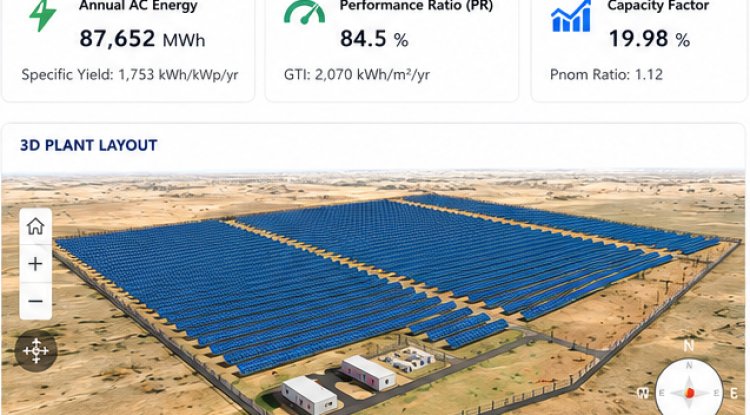
Energy simulation Comparison
PR Newswire: This article is written by the makers of one of them, so each table below also shows where the others are ahead, and the last section lists what V9 does not do yet.
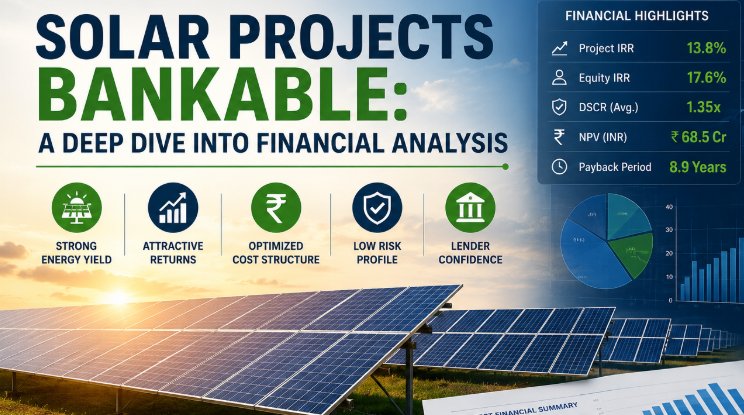
IST PVSolar Simulator, PVsyst 8, HelioScope and RatedPower: An Honest Comparison
The four tools do different jobs, so the right one depends on the project and on who has to trust the result.
- PVsyst 8 is the yield study that lenders and independent engineers ask for by name.
- HelioScope is the fast, browser-based design and simulation tool for commercial and industrial roofs, mainly in markets where its data and rate libraries are strong.
- RatedPower designs utility-scale plants on real terrain and produces their engineering documents.
- IST PVSolar Simulator V9 takes a commercial roof from a drone image to a proposal, drawings and a lender file in one project, with Indian costs and taxes built in.
No tool here wins every row. This article is written by the makers of one of them, so each table below also shows where the others are ahead, and the last section lists what V9 does not do yet.
Four tools, four jobs
Each product was built around a different deliverable, and that explains most of the differences that follow.
|
|
IST PVSolar Simulator V9 |
PVsyst 8 |
HelioScope |
RatedPower |
|---|---|---|---|---|
|
Built for |
Commercial and rooftop projects: design, yield, finance and proposal |
Detailed energy yield studies |
Commercial and industrial design and simulation |
Utility-scale PV, battery storage and hybrid plants |
|
Typical project |
A factory or warehouse roof, or a small ground area |
Any size, where the number will be audited |
Commercial roofs and ground mounts |
Ground-mount plants of 5 MW and above |
|
Runs on |
Web browser |
Windows desktop |
Web browser |
Web browser (cloud) |
|
Main output |
One project file feeding report, drawings, bill of quantities, proposal and lender file |
The simulation report with its loss diagram |
Layout, production report and proposal |
Over 400 pages of technical documents per design |
|
Owner |
IST Sunpower System, India |
PVsyst SA, Switzerland |
Aurora Solar |
Enverus |
A designer rarely chooses between all four. The real choice is usually between two of them for a given kind of project, and the sections below are arranged to make that choice easier.
Energy simulation
On the energy model itself, PVsyst and RatedPower go deepest, HelioScope resolves shade at the finest level on a roof, and V9 sits between an array-level and a module-level method.
|
|
IST PVSolar Simulator V9 |
PVsyst 8 |
HelioScope |
RatedPower |
|---|---|---|---|---|
|
Time step |
Hourly. The 15-minute option interpolates hourly data |
Hourly or sub-hourly |
Hourly, 8,760 steps |
Hourly; its published method also covers sub-hourly steps |
|
Weather data |
PVGIS or NASA hourly data. Other providers only as twelve monthly values |
Imports hourly and sub-hourly files from the main providers |
Built-in typical-year datasets and uploads |
The user's own weather, horizon and albedo data, or built-in sources |
|
Near shading |
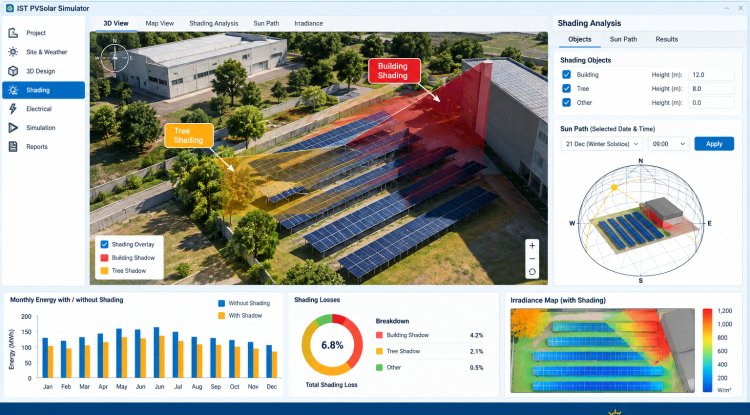
Per area and per string, read at the sun's position each hour. A module counts as lit or shaded at its centre. Objects also reduce diffuse light |
3D scene; models the bypass diodes inside a module |
Shadow mapped per module, hour by hour |
Ray-traced module by module on the real terrain |
|
Electrical model |
Each sub-array on its own inverters. One sub-array across two roof faces shares its inverter limit |
Sub-arrays and inverter inputs defined one by one |
A current-voltage curve for each module |
Plant-scale DC and AC losses, cables and transformers |
Two rows matter most in practice. Weather data decides whether a lender's preferred source can be used at all. The time step decides how well clipping is counted when the DC array is much larger than the inverter. On weather data V9 is behind all three today. On the time step it is level with HelioScope and behind PVsyst and RatedPower.
Design and layout
Layout is where the tools differ most by project type. RatedPower automates a whole plant on terrain, HelioScope and V9 work on roofs, and PVsyst is a simulation tool, not a design canvas.
|
|
IST PVSolar Simulator V9 |
PVsyst 8 |
HelioScope |
RatedPower |
|---|---|---|---|---|
|
Starting point |
A drone or satellite image traced by the designer; boundary from GeoJSON or KML |
A 3D shading scene built or imported for the simulation |
Layout drawn in the browser;LIDAR-assisted modelling and automatic obstruction detection on the Pro plan |
Site boundary, exclusion areas and topography; the software scans many layouts and picks the best |
|
Rooftop detail |
Roof faces, parapets, rooftop objects with heights; shaded modules marked on the plan by cause |
Not a roof layout tool |
Roof layout with obstructions |
Not built for rooftops |
|
Structure and height |
3D view with posts, footing blocks and rails; a finder for the mounting height with the highest rear-side gain |
Height entered as a simulation input |
Racking chosen as a design input |
Structures, trackers and earthworks for the plant |
|
Terrain and large sites |
Flat roofs and flat ground areas only |
Terrain can be imported for shading |
Commercial ground mounts |
Its main strength: terrain, cable routing, substation |
|
Battery storage |
Battery sizing for self-use and peak shaving |
Storage strategies in the simulation |
Storage modelling on higher plans |
Standalone and hybrid battery plants |
For a roof, the practical comparison is V9 against HelioScope. HelioScope is ahead on automatic site modelling from LIDAR. V9 is ahead on site detail a designer hands to the installer: parapets, structure, and the shaded modules named by cause.
Documents and finance
This is where V9 is strongest for a commercial project, and where RatedPower is strongest for a utility-scale one.
|
|
IST PVSolar Simulator V9 |
PVsyst 8 |
HelioScope |
RatedPower |
|---|---|---|---|---|
|
Yield report |
Simulation report with loss diagram and single-line diagram |
The reference report in the industry |
Production report with a loss tree |
Energy yield and design reports |
|
Drawings |
Wiring diagram, cable schedule with route diagram |
A basic single-line diagram |
Layout and wiring design |
Single-line diagrams, layouts and interconnection reports |
|
Bill of quantities and proposal |
Both, from the same project |
Outside its scope |
Proposals on the Pro plan; reviewers find them weak |
Bid documents with cost analysis |
|
Financial model |
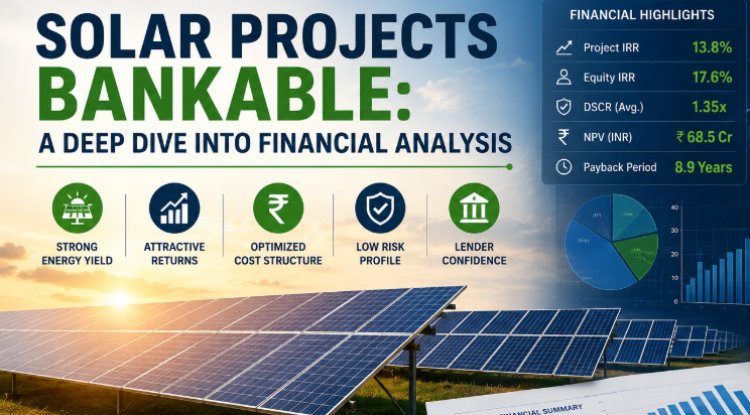
LCOE, NPV, IRR and payback, plus debt cover ratios tested against a lender's own limits, with a Monte Carlo on returns |
Economic evaluation of the simulated plant |
Financial modelling on the Pro plan |
CAPEX and financial outputs for the plant |
|
Lender file |
Bankability report in twelve chapters and a due diligence checklist |
Not a stated feature |
Not a stated feature |
Not a stated feature |
"Not a stated feature" means it does not appear in the vendor material reviewed for this article. The reviews linked for HelioScope and RatedPower are published by a company that sells a competing product, so read them with that in mind.
Which one to choose
Match the tool to the project and to the person who must accept the result.
|
Your project |
Best fit |
Why |
|---|---|---|
|
Residential, Commercial or industrial roof, owner-funded or simply financed any type solar project |
IST PVSolar Simulator V9 |
Automatic Layout, shading, drawings, bill of quantities, proposal and lender file from one project, with Indian costs and taxes |
|
The same roof, where the lender's engineer will check the yield |
V9 for design and documents, plus a PVsyst report |
The engineer expects the named report |
|
Commercial roofs in volume, in a market with good LIDAR and rate data |
HelioScope |
Fast modelling of the site and per-module shading |
|
Utility-scale plant on real terrain, with or without storage |
RatedPower |
Automatic layout, terrain, cabling, substation and hundreds of pages of bid documents |
|
Any project where the yield study itself is the deliverable |
PVsyst 8 |
Depth of the simulation and acceptance by financiers |
|
DC array much larger than the inverters, or a strict export limit |
PVsyst 8 or RatedPower |
Sub-hourly simulation counts clipping that hourly steps smooth out |
Many offices will run two of these. The common pair for commercial work is a design-and-documents tool for the daily job and PVsyst for the projects that need it.

Industry and Business: Industry and Business research is an important part of creating business and strategic plans and blends consumer behavior and economic trends to confirm and improve your business idea.