IST EVCS Simulator | EV Charging Station Design for EPCs
PR Newswire: IST EVCS Simulator helps EPC teams design EV public charging stations: load, transformer, cables, protection, solar, BESS, BOQ and financials in one tool.
IST EVCS Simulator (Software): Designing and Simulating EV Public Charging Stations
Most EV public charging stations (EVCS) don’t fail because of the chargers. They fail because of decisions made before a single cable is laid: an undersized transformer, a missed fault-level check, a protection scheme that doesn’t coordinate, or a business case built on optimistic utilisation.
For an EPC contractor, these mistakes get expensive. A transformer upgrade after award, a redesigned earthing system, or a DPR that doesn’t survive the client’s technical review can erase the margin on a project.
Design usually still lives in a patchwork of Excel sheets, AutoCAD files, vendor catalogues and separate financial models. Each hand-off is a chance for an error.
The IST EVCS Simulator brings that workflow into one browser-based engineering tool. Project inputs go in, and a connected design, simulation, bill of quantities and financial model come out.
What is the IST EVCS Simulator?
The IST EVCS Simulator is an engineering design and simulation software for EV charging stations. It runs entirely in a browser, and you can launch it by opening a single file. It covers the full chain from site survey to the Detailed Project Report (DPR):
- Site survey and layout, with project location, coordinates and grid connection
- EV charger database with 110 records, including Indian and global OEM models
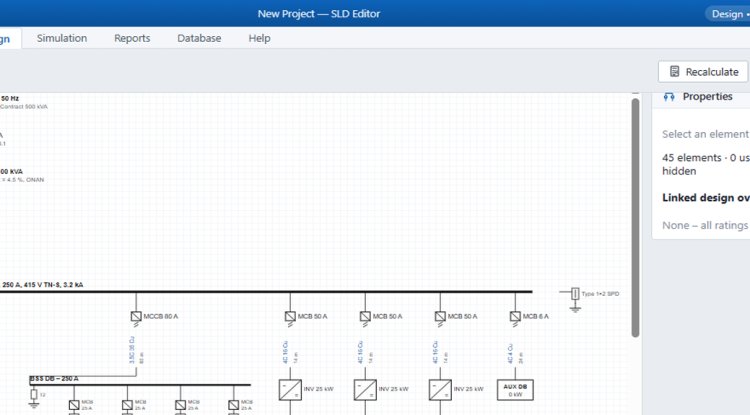
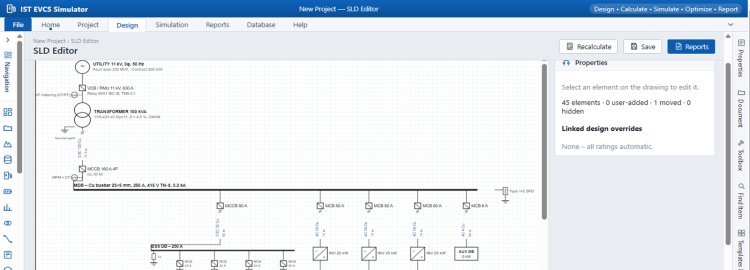
- Electrical design: load and maximum demand, transformer sizing, cable sizing, MDB/ACDB, protection, earthing and an editable single-line diagram (SLD)
- Solar PV and battery storage (BESS) sizing
- EMS simulation with five energy-management strategies and a comparison view
- Energy simulation at 15-minute resolution across 12 representative days
- Financial analysis: NPV, IRR, payback, levelised cost of charging (LCOC) and sensitivity
- BOQ, DPR and exports: Excel/CSV, DXF, SVG/PNG and PDF
It also includes a dedicated Battery Swapping Station (BSS) module, which is useful if your pipeline includes 2W/3W swapping.
Six station architectures, one tool
EPCs rarely build the same station twice. The simulator’s Project Type setting configures the whole system architecture in one selection:
- Grid-connected EV charging station
- Solar PV + Grid (net metering)
- Solar PV + BESS + Grid (peak shaving)
- Standalone Solar + BESS (off-grid)
- Solar + BESS + Grid + diesel generator (with ATS and an outage window)
- Smart charging / V2G-integrated station
Choosing a type pre-sets PV, BESS, grid, export, EMS strategy and backup options. Every input can still be edited afterwards, so the type is a starting point rather than a constraint.
How it helps EPC teams
1. Faster, more consistent pre-bid design
Change the charger mix, and load, transformer loading, fault level, cable schedule, SLD and BOQ update together. That makes it practical to evaluate several configurations during the bid window instead of committing to the first one that works.
The bundled sample projects show the idea. A 10-unit city fast-charging hub (388 kW rated) resolves to a 500 kVA transformer at roughly 67% loading, with a 15.55 kA fault level and a budgetary CAPEX of about ₹3.0 crore. A 12-unit highway plaza (about 750 kW rated) resolves to an 800 kVA transformer. These are illustrative examples, not benchmarks, but they show how much comes out of one set of inputs.
2. Electrical design that goes beyond sizing
The tool covers what often gets deferred to later:
- Protection selectivity and TCC, with trip curves per IEC 60898-1, IEC 60947-2 and IEC 60255-151, a check on every upstream/downstream pair, and auto-coordination
- Harmonics and power quality per IEEE 519-2022, plus transformer derating, APFC sizing and resonance checks
- Earthing by both the IS 3043 method and the IEEE 80-2013 ground-grid method, with an auto-design option
- Short-circuit levels and cable sizing with derating factors
Catching a coordination or harmonic issue in the model is far cheaper than catching it at commissioning.
3. A defensible business case, not just a drawing
Charging station economics depend on utilisation, tariff structure and demand charges. Because the 15-minute energy simulation feeds directly into the financial model, NPV, IRR, payback and LCOC reflect how the station behaves over a year, including solar fraction, peak grid draw and unserved demand. Sensitivity analysis shows how fragile the case is if utilisation or tariffs move.
4. Smarter solar and storage decisions
With PV in the picture, the simulator imports PVGIS Typical Meteorological Year (TMY) data for the site’s coordinates, so the yield is based on the site rather than a generic reference. The EMS comparison then shows what BESS and peak-shaving strategies actually deliver on the load profile, which supports right-sizing instead of over-specifying expensive batteries.
5. Battery swapping, designed properly
The BSS module sizes chargers from the swap demand (P = N·E·ΔSOC / (t·η)), plans pack inventory, designs the electrical system, and runs a pack-by-pack simulation covering arrivals, queues, charge profiles, thermal behaviour and battery health. This matters for EPCs entering swapping, where the cost is in pack inventory and charger pooling.
6. Traceable, reviewable deliverables
Projects save as a single .cspro file holding inputs, full results, a database snapshot and integrity checksums. When a colleague or client reopens the file, the tool re-runs the calculation and verifies the results match. Output includes the DPR, BOQ in Excel, cable schedule, SLD and layout in DXF, and the 15-minute simulation as CSV.
7. Your data, your rates
The component database is open JSON. EPCs can import their own charger, cable and breaker records, update costs, and track every change with a time stamp and a reason in the revision history.
Who should use it
- EPC contractors and system integrators preparing bids and DPRs
- Charge point operators (CPOs) evaluating site feasibility and returns
- Consultants and utilities reviewing proposed charging infrastructure
- Fleet and real-estate developers planning depots, plazas and parking sites
Getting started
This software access available with EV Charging Station Design course offered by Institute of Solar Technology (IST)
Conclusion
EV charging is becoming a serious infrastructure business, and the margin sits in design quality. The IST EVCS Simulator gives EPC teams a way to test configurations, check the electrical design, and attach a financial case to each, all before procurement starts. The result is fewer surprises on site and more credible proposals.

ESS News: Energy storage system development, latest news, press release, analysis and opinion from the global energy storage industry.