IST PVSolar Simulator V9.0.0
PR Newswire: IST PVSolar Simulator: The integrated Indian-origin PV engineering platform connecting design, physics simulation, electrical calculations, energy yield, BESS, economics, bankability, multi-simulation optimization, SCADA validation and research in one workflow. That is the strongest global competitive story for IST PVSolar Simulator —not "IST PVSolar Simulator have more features than PVsyst," but "IST PVSolar Simulator connect more stages of the solar engineering lifecycle in one platform."
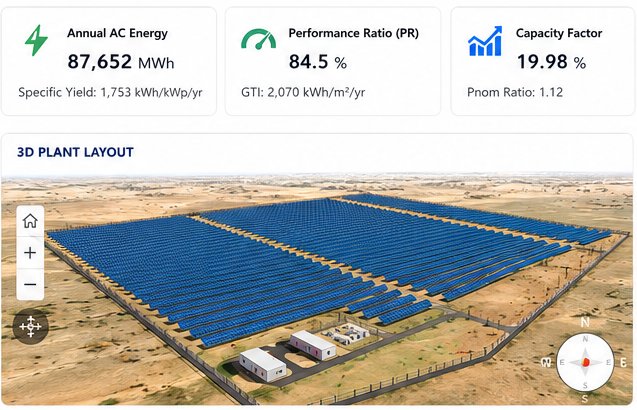
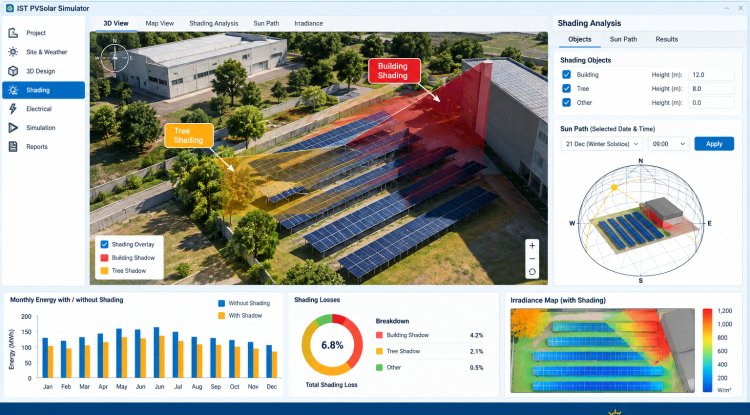
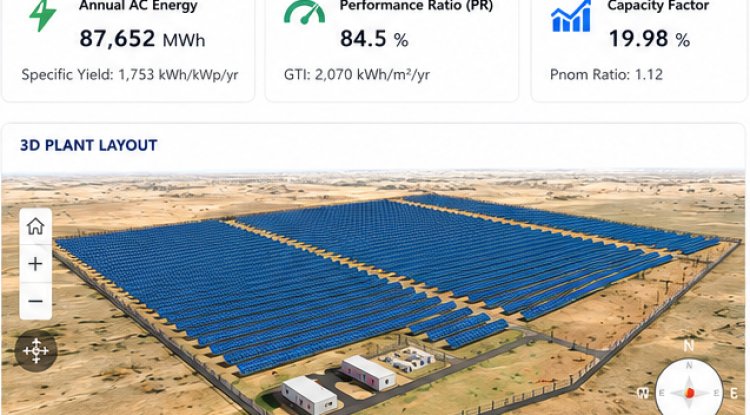
IST PVSolar Simulator V9.0.0 interface Based on the current feature set, its strongest differentiator is that it is not merely a PV yield calculator; it is evolving into a design → physics simulation → electrical design → financial analysis → bankability → research platform.
The most important advanced features
1. Hourly / Sub-hourly physics-based simulation — ⭐⭐⭐⭐⭐
This is arguably the most important feature.
The simulator can work with hourly/sub-hourly solar-resource data, rather than relying only on monthly average calculations. That enables the engine to model the interaction between:
Sun position → irradiance → POA → temperature → PV I-V/P-V behavior → inverter → clipping → losses → AC energy.
2. Advanced POA transposition — ⭐⭐⭐⭐⭐
The simulator explicitly uses a anisotropic diffuse model + beam transposition, rather than a simple cosine/isotropic approximation. This is a major technical feature because POA irradiation is the starting point for the actual PV energy model.
3. Physics-based single-diode PV model — ⭐⭐⭐⭐⭐
The module I-V/P-V curve is generated using a single-diode De Soto model, calibrated against module electrical parameters such as: Voc, Isc, Vmp, Imp, Pmax, Rs, Rsh, temperature coefficients.
4. Real electrical shading / bypass-diode model — ⭐⭐⭐⭐⭐
This is one of the most impressive technical features. The simulator doesn't simply say: "10% of the module is shaded → 10% energy loss."
It models reverse bias and bypass-diode behavior at the substring level.
5. Unlimited-sheds bifacial model — ⭐⭐⭐⭐⭐
The simulator includes a geometry-based bifacial model using: module height, row spacing/pitch, GCR, ground type, albedo, front POA, rear POA,bifaciality factor, That is important for modern bifacial utility-scale design.
6. Full loss-chain simulation — ⭐⭐⭐⭐⭐
This is another major strength.
The simulator separately handles losses such as: thermal, DC wiring, AC wiring, mismatch, LID, degradation, soiling, IAM, spectral, shading, inverter, auxiliary, clipping, transformer, grid/cable, export limitation.
7. Advanced inverter modeling — ⭐⭐⭐⭐
The inverter model includes: AC rated power, DC input limits, MPPT range, MPPT configuration, DC/AC ratio, clipping, efficiency curve, inverter auxiliary consumption
The current interface can generate an efficiency curve from Max/Euro efficiency or actual load points, with an AI-refinement option.
8. DC/AC ratio + clipping optimization — ⭐⭐⭐⭐⭐
The simulator doesn't treat inverter sizing as simply: DC = AC It calculates: ILR = Pdc / Pac and tracks clipping.
It can therefore answer an important engineering question:
Should I use 1.05, 1.10, 1.20, 1.30 or 1.40 DC/AC ratio?
The correct answer is not necessarily the highest energy. The objective is Maximum economic return,
9. 3D shading + shadow-free pitch design — ⭐⭐⭐⭐⭐
The simulator has a dedicated 3D shading model and satellite roof-layout capability.
It can consider: module dimensions, tilt, module stacking, row spacing, front-edge height, parapet, shading window, azimuth, GCR.
It can also trace a roof/ground outline on satellite imagery and generate a shadow-free layout. This moves the software toward PV simulation + preliminary layout engineering rather than simulation alone.
10. Single-Axis Tracker simulation — ⭐⭐⭐⭐⭐
The SAT engine is particularly advanced.
It includes: true tracking, backtracking, GCR, tracker geometry, solar position, Perez POA, thermal model, soiling, degradation, DC wiring, availability, parasitic power, clipping.
The application also supports a genuine per-timestep tracker re-simulation for the bankability results.
This is important because tracker optimization is fundamentally an hourly geometric problem.
11. Battery + PV self-consumption simulation — ⭐⭐⭐⭐⭐
The simulator goes beyond PV generation.
It can simulate: PV → Load → Battery → Grid with hourly load profile, battery capacity, battery power, round-trip efficiency, minimum SOC, initial SOC, self-consumption, peak shaving, grid export limit, weak-grid/islanding mode. It can also optimize battery capacity against self-consumption ratio.
This makes the platform relevant to C&I, rooftop, captive, hybrid, BESS, peak shaving, projects.
12. Transformer + grid-delivery modeling — ⭐⭐⭐⭐⭐
This is a feature I would highlight strongly in your marketing.
The simulator doesn't stop at inverter AC output. It includes transformer no-load loss, transformer copper loss, cable loss, grid export limit, grid interconnection voltage.
The current interface explicitly provides LV/MV and MV/HV transformer loss inputs.This makes the reported AC/grid-delivered energy more realistic for utility-scale projects.
13. Grid-code-aware simulation — ⭐⭐⭐⭐½
The simulator includes a grid-code section covering: LVRT, HVRT, reactive-power reserve, power factor, ramp-rate limiting. It references Indian CEA/IEGC as well as IEEE 1547 and EN 50549.
An important distinction is already documented in the interface: LVRT/HVRT certification is treated primarily as a compliance record, while reactive power and ramp-rate restrictions can affect annual energy.
14. Lifetime degradation simulation — ⭐⭐⭐⭐⭐
This is stronger than simply applying:
The simulator has year-by-year aging analysis and can reconstruct degraded module behavior using current and voltage degradation channels.
It can also compare module degradation, age-driven mismatch, manufacturer warranty guarantee, yearly AC energy, PR degradation. This is highly relevant for 25-year financial modeling.
15. Uncertainty / P50-P95 — ⭐⭐⭐⭐⭐
For bankability, this is extremely important. The simulator supports using uncertainty inputs including interannual variability, resource uncertainty, model uncertainty, component uncertainty.
The documented equations generate P50/P75/P90/P95 from combined uncertainty. This changes the question from "How much energy will the plant generate?" to:
"What is the probability that the plant will generate at least this amount of energy?"
That is much closer to bankability analysis.
16. Financial simulation — ⭐⭐⭐⭐⭐
The financial engine calculates:- LCOE, NPV, IRR, EMI, lifetime cash flow, revenue, OPEX, degradation and project economics. The documented formulas include discounted LCOE, NPV and iterative IRR calculation.
17. Multi-simulation comparison — ⭐⭐⭐⭐⭐
This is particularly relevant to the analysis you showed earlier.
Instead of running one design and accepting the result, the simulator can maintain multiple simulation scenarios and compare:- PR, Yf, Pnom ratio, clipping, DC capacity, AC energy, CAPEX and income and provide an optimum simulation recommendation.
This is a very powerful concept:
The simulator is not only predicting performance; it is helping select the design.
Where V9 is genuinely different
- PVsyst has enormous industry acceptance and very mature yield modeling.
- SAM is exceptionally strong for open research and detailed financial/technology modeling.
- PV*SOL is extremely strong in 3D/string-level desktop design.
- HelioScope/Aurora are strong in fast cloud design.
- SolarFarmer/PlantPredict/3E/Solargis are strong utility-scale specialist platforms.
- HOMER is stronger for microgrid optimization.
The potential strength of IST V9 is the breadth of the integrated workflow.
Its current interface explicitly combines Project/Site, System Design, Loss Calculation, Economics Evaluation, Simulation, Research and Databases in one platform.
My assessment
If I were positioning IST PVSolar Simulator V9.0.0 against conventional PV calculators, I would emphasize these 10 flagship capabilities:
- Hourly/sub-hourly physics simulation
- Single-diode PV + I-V/P-V modeling
- Electrical partial-shading + bypass-diode modeling
- Bifacial infinite-sheds geometry
- Tracker + backtracking simulation
- Complete DC → inverter → transformer → grid loss chain
- 25-year degradation + mismatch modeling
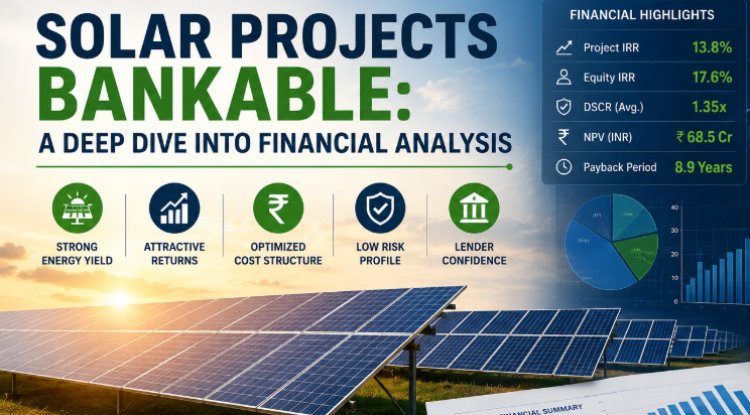
- P50/P90/P95 uncertainty/bankability analysis
- Simulation vs actual SCADA benchmarking
- Technical + economic + financial multi-criteria optimization
These collectively make the product much more than a "solar calculator." The strongest positioning is:
IST PVSolar Simulator is a design-to-simulation-to-bankability platform that connects solar resource, PV physics, electrical design, loss modeling, grid delivery, financial performance, uncertainty analysis and real-plant validation in one workflow.
That claim is much stronger than simply saying "PV yield simulation software."

RE News: Renewable energy Latest News & Resources - including solar, wind, hydropower, biofuels and others new and appropriate energy generation technology.